




The European turtle dove (Streptopelia turtur) is a species threatened with extinction, yet it remains a game species in various countries, including Spain. In 2018, an International Action Plan was introduced to halt several decades of population decline across Europe, setting recovery as its goal. The plan proposed an adaptive hunting management system to regulate the hunting of the species. This system, promoted and overseen by the European Commission, was implemented with scientific advice provided by a consortium of research agencies led by the Institute for Game and Wildlife Research (IREC – CSIC, UCLM, JCCM). The scientific advisory included management recommendations based on the best available information regarding the turtle dove’s demography on a European scale.
This group of scientists developed a population model and analyzed various alternative scenarios that could lead to the species’ population growth. All scenarios pointed to a higher chance of recovery if hunting was temporarily suspended, suggesting that such a drastic measure could buy the time necessary to implement suitable actions to ensure the sustainability of any future exploitation. Based on these findings, scientists recommended a moratorium across the species’ migratory route, which was enacted in 2021 and remains in effect to this day.
Now, a new research study led by scientists from the Wildlife Ecology and Management Research Group at IREC, recently published in the prestigious journal Conservation Letters, reveals the response of European turtle dove populations to the hunting moratorium, reflected in the number of breeding individuals in 2022 and 2023, following the first two years of the moratorium.
The data compiled and analyzed annually by the Pan-European Common Bird Monitoring Scheme (PECBMS) shows that the continued decline in the western flyway reached its lowest point in the spring of 2021, with 1.56 million breeding pairs. However, since the beginning of the moratorium, the population has started to recover, reaching 1.96 million pairs in just two years (2023), representing an increase of 400,000 breeding pairs, or 25%.
This new study also highlights that the management measures adopted in the central-eastern flyway were less stringent, initially because the decline observed was less severe. Instead of a full moratorium, hunting efforts were merely reduced during the same period. As a result, the population of European turtle doves in the central-eastern migratory route continued to decline, hitting a historic low in 2023 with 0.56 million pairs, a 15% decrease compared to 2021.
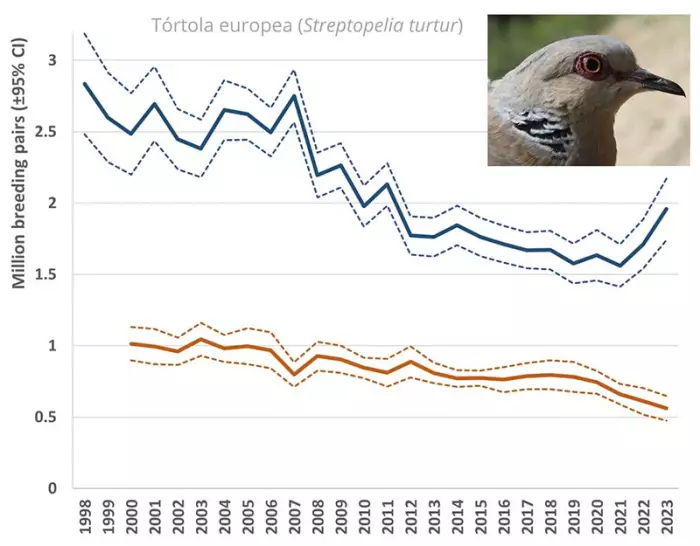
Evolution of the estimated number of breeding European turtle doves in the western flyway (top; in blue) and the central-eastern flyway (bottom; in red) from 1998-2023. The dotted lines represent 95% confidence intervals. The western flyway includes countries like England, the Netherlands, western Germany, France, Spain, Portugal, and western Italy, while the central-eastern flyway includes eastern Germany, Poland, the Czech Republic, Austria, most of Italy, Malta, Hungary, Romania, Bulgaria, and Greece.
The rapid population recovery observed in the western flyway, combined with the lack of response to the partial hunting reduction in the central-eastern flyway, confirms that the temporary hunting moratorium was an effective short-term management measure. Field observations in Spain indicate that the moratorium coincided with two consecutive seasons of low reproductive success due to drought and extreme heat, but after the hunting suspension, individual survival increased, likely laying the foundation for the recovery.
In the long term, the possibility of resuming turtle dove hunting within an adaptive management framework remains open, as long as specific conditions are met. Future hunting will need to be sustainable and science-based, with ongoing population monitoring by the PECBMS program.
The recently published study underscores the European turtle dove as a successful example of science-based management of a threatened game species. The adaptive management system developed for this species is the first of its kind for a terrestrial bird on a large scale in Europe, and it sets a precedent for managing other species in similar situations within the European Union. In fact, the case of the European turtle dove highlights the immense potential for cooperation between wildlife policy and science, and the European Commission has already started applying this approach in a contract with IREC for managing other game species in poor conservation status within the European Union.
You can access the scientific publication of this research at:
- Carboneras, C., Šilarová, E., Škorpilová, J., Arroyo, B. 2024. Rapid population response to a hunting ban in a previously overharvested, threatened landbird. Conservation Letters, e13057.
Este artículo también está disponible en español: La tórtola europea se recupera gracias a la gestión cinegética adaptativa